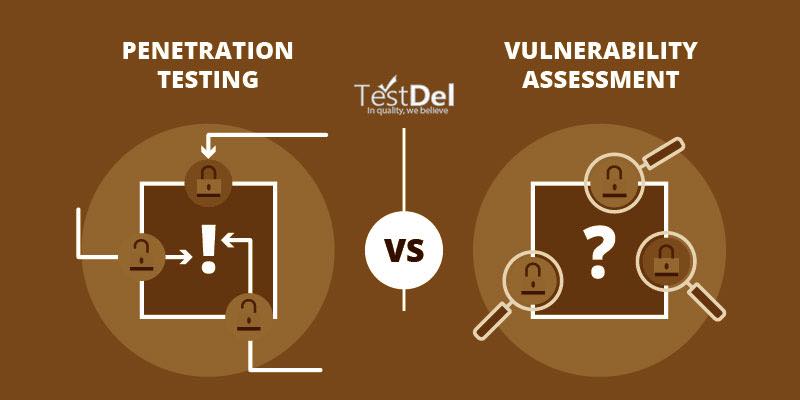
It surprises us how so many people seem to confuse the significance of vulnerability assessment with penetration testing. Vulnerability assessment cannot substitute penetration testing, and penetration testing cannot protect the entire system on its own. Both are critical at their corresponding locations, needed in internet risk assessment, and made mandatory by standards such as PCI, HIPPA, ISO 27001, and others.
Vulnerability assessment tests for security issues and generates a report on risk exposure, while penetration testing exposes a vulnerability in your device architecture. The success of penetration testing or vulnerability scanning is largely determined by three factors.
- Objective
- Asset Risk and Robustness
- Time and Cost
Penetration testing vs. vulnerability evaluation is a subject that often sparks heated debates, not just about which is better, but also about the significance of these software security measurement approaches. Let’s take a look at these two topics and see what they’re all about.
1. Difference between Penetration Testing and Vulnerability Assessment
1.1. Penetration Testing
The spectrum of penetration testing is narrowed, and the human element is still present. There is no such thing as automatic penetration testing. Penetration monitoring necessitates the use of tools often a large number of them. Penetration testing necessitates the use of a highly skilled individual. A successful penetration tester will often write a script, adjust the conditions of an operation, or modify the configurations of the tools she is using at a certain stage during their testing.
It may be at the application or network level, but it would only apply to a particular role, unit, or a number of assets. While it is possible to include the entire network systems as well as all software, this is unrealistic in the actual world due to time and cost constraints. You identify your reach based on a variety of variables, the most important of which are risk and asset importance. It’s not realistic to spend loads of money on low-risk assets that might take several days to hack. Penetration testing is expensive because it necessitates highly specialized expertise. Penetration testers commonly find new vulnerabilities or discover previously unknown vulnerabilities that are unknown to the business processes. Penetration testing can require anything from a few days to several weeks in most cases. It’s usually done once every year, and the documents are short and simple. Penetration testing has a higher-than-average risk of triggering service interruptions.
1.2. Vulnerability Assessment
The process of finding possible vulnerabilities in system devices such as firewalls, routers, switches, servers, and applications is known as vulnerability scanning. It is computer-assisted and helps in identifying possible and existing vulnerabilities on the network or in applications. It does not take advantage of the flaws. Vulnerability scanners only detect possible flaws; they do not manipulate them. As a result, they aren’t designed to find zero-day vulnerabilities. The scope of vulnerability scanning is enterprise-wide, requiring automated software to handle a large number of properties. Its spectrum is much broader than penetration testing.
To use the vulnerability scans product effectively, you’ll need product-specific information. Admins or security personnel with strong networking skills are typically in charge of it. Vulnerability scans may be performed on a large number of assets on a regular basis to ensure that established vulnerabilities are identified and fixed. As a result, you can easily remove more critical vulnerabilities for your important assets. Following the vulnerability management lifecycle is an essential aspect to rectify vulnerabilities. As contrasted to penetration testing, the expense of a vulnerability scan is reasonably low, as it is an investigator rather than preventive control.
For successful patching, vulnerability management can be fed into security patches. Before being rolled out to output, patches must be reviewed on a test device.
2. Conclusion
Vulnerability scanning and penetration testing can both contribute to the cyber risk management process and aid in determining the regulations that are suitable for the company, unit, or practice. To lower cybersecurity risks, they must all work collectively. It’s critical to understand the distinctions, each is critical and serves a different function.
Training is also necessary because the security team has access to tools does not imply the environment is safe. A greater security risk arises from a lack of expertise about how to use tools effectively. Your groups would be able to provide ROI in terms of efficiency, a clear picture of an organization’s security posture, and reduced time and costs wasted on needless troubleshooting if they have a thorough understanding of security tools.
“Which one is the best to offer the customers?” is possibly the question now. You might realistically assume that everything relies on the consumer and his plan at this stage. Although this appears fair, most people tend to conduct a project-specific vulnerability assessment. The explanation for this is generally due to the customer’s technological sophistication, and vulnerability assessment appears to be the best option for customers almost all of the time.
TestDel is a multi-award-winning penetration testing company. Our penetration testing services assist organizations in effectively managing cyber security risk by finding, safely exploiting, and assisting in the remediation of vulnerabilities that could otherwise lead to malevolent attackers compromising data and assets.