Software Testing is a method to check whether the actual software product matches expected requirements and to ensure that the software product is Defect free. It involves the execution of software/system components using manual or automated tools to evaluate one or more properties of interest. In contrast to actual requirements, software testing’s goal is to find mistakes, gaps, and missing requirements.
The significance of thoroughly testing your software solution prior to its deployment cannot be overstated. The reasons are self-evident: a fully tested solution does not bother its users with bugs, problems, or poor performance. As a result, the higher the consumer engagement and retention rates, the better the user experience.
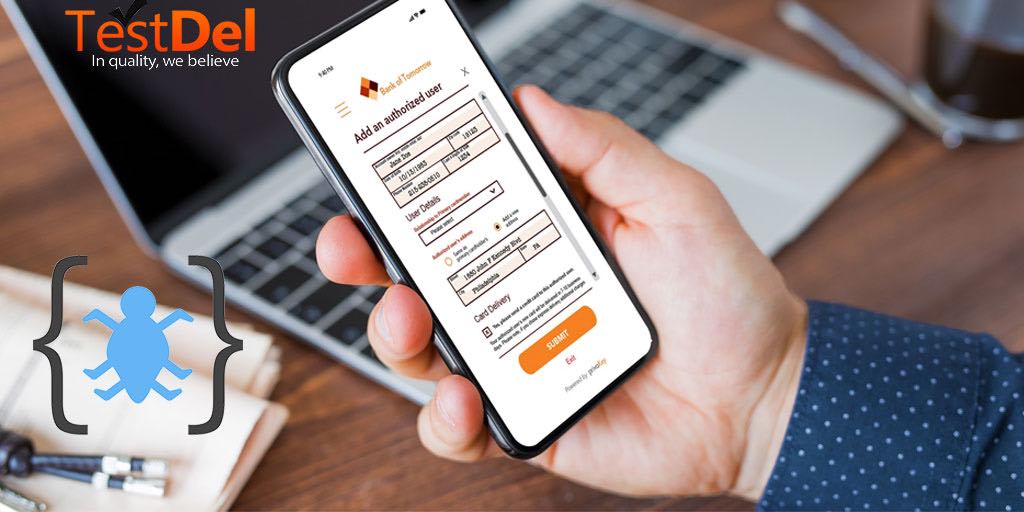
Testing mobile banking apps is not at all like testing any other mobile app. What steps can you take as a product owner to ensure that your mobile banking app is tested extensively? To discover it, continue reading the blog.
1. Important Aspects that Must be Tested
Initially and most importantly, you must understand which tests should receive special attention during mobile application testing. Mobile banking apps have unique requirements, such as regulatory compliance and the security of sensitive user data – we’ve selected some of the most important aspects that should be thoroughly tested and these are as follows.
1.1. Data Security for Users
Mobile banking apps acquire, analyze, and retain a large amount of personal information related to the user’s bank account. They can also be used for transaction authorization. Your image will be harmed if your app experiences a data breach. As a result, here are three things to keep in mind when testing financial applications:
- The data must be properly encrypted (end-to-end encryption and conformity with sophisticated standards like AES-256 are required);
- The user’s device and your servers must have a secure connection.
- Data that is no longer required should be permanently removed.
Vulnerability testing of the entire system is critical for detecting and eliminating potential exploits. Moreover, TestDel recommends that you do a penetration test before and after the release of your software.
1.2. User Interface and User Experience
The importance of user interface and user experience testing is self-evident, a positive user experience leads to high consumer satisfaction. You’ll need a range of UI/UX software testing services to get there. In a summary, you must conduct usability tests to ensure that all elements function properly. Following that, your QA company must test certain hypotheses about user behavior. They can use heat maps to track how the app is being used, conduct UX interviews with real-life users from your target audience to determine the inconveniences, A/B testing, and other methods to accomplish this.
1.3. Compatibility
The quality of the user experience is dependent on device compatibility. Because there are a variety of devices with varied screen sizes, resolutions, and operating systems, you must guarantee that your app looks great on all of them. Compatibility testing is used to identify and correct discrepancies or problems in fonts, graphics, element presentation, functionality, and other areas. App testing businesses can do this by running your app on emulators (desktop apps that simulate various mobile devices) or real devices – we recommend the latter because emulators can lead to incorrect results and do not represent all of a device’s characteristics.
1.4. Quality and Performance
Mobile banking apps must deal with massive amounts of data, and their inability to do so will undoubtedly negatively affect the user experience.
To avoid this, your software testing business should put the system through a series of tests to see how reliable and responsive it is, as well as identify the system’s primary flaws that need to be addressed. The following should be included in performance tests:
- Load testing (to see how the app behaves under different loads);
- Stress testing (to determine the maximum load capacity of the system);
- Soak testing (to ensure the program can continue to function under a constant load).
- Spike testing (to see how the app reacts when the load is suddenly increased or decreased)
1.5. Conformity
Banking mobile applications must adhere to a variety of norms and standards, both national and international. GDPR and ISO 12812 are the two most important. Your app must feature data protection by design by default to comply with GDPR. Moreover, you must ensure that you can carry out the rights of your EU-based users, which include:
- The right to know what types of personal data are collected, how they are processed, and for what reasons they are used;
- The right to permanently delete personal data.
The ISO 12812 standard covers security and data protection, as well as transaction processing for people and businesses, and financial app management solutions.
2. Strategies for Effective QA Testing
So, whether you utilize in-house or outsourced software testing services, here are six suggestions to ensure a successful collaboration:
- Make regular and continuous testing a priority to catch bugs
- Use both manual and automated testing (automated testing saves time, but manual testing is necessary for UI/UX and other tests);
- Not simply emulators, but genuine devices should be used to test the app.
- Attempt to replicate real-world user conditions so that the results are deceiving.
- Consider incorporating real-world user feedback into the app’s development.
- Be a part of the process from the start (during requirements gathering, their review, etc.)
Conclusion
It’s much more necessary to test a mobile banking app than it is to test a standard one. Because your app will handle very sensitive user data, security testing is essential. Conformity with some regulations is also not an option, although maintaining a high level of user experience is a necessity of surviving the fierce competition. Therefore, in addition to security, many testers on the development team must pay attention to other crucial aspects such as functionality, security, and performance while using typical app testing methodologies. Mobile bank apps use confidential data like phone numbers, addresses, bank account information.
Overall, when it comes to testing, make sure you hire the services of a professional firm. Fortunately, you’ve arrived at the correct location. Contact TestDel today to assure the quality of your app and to take advantage of outsourcing testing services.