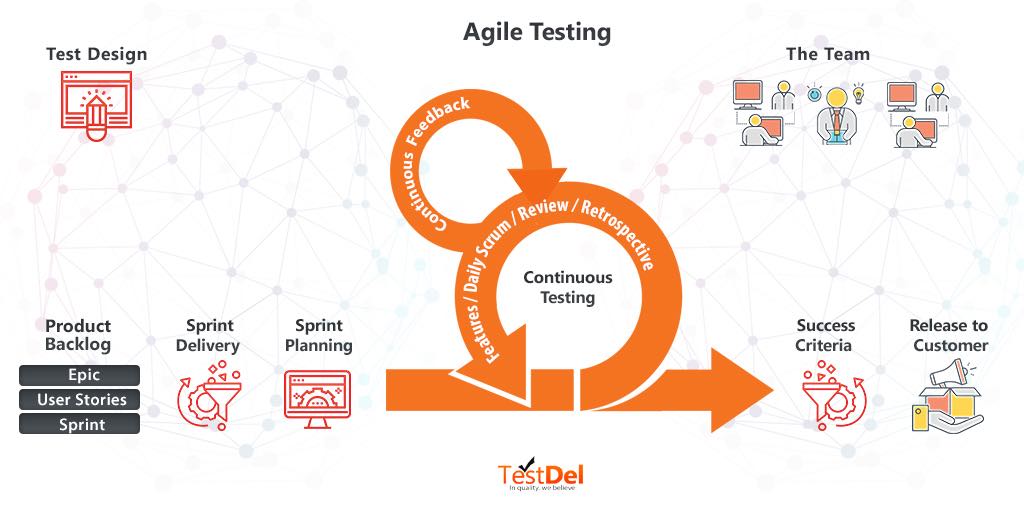
In agile, the testing is only one aspect of the lifecycle of software development. It runs alongside the development effort on a continuous basis and is a collaborative effort between testers, developers, product owners and even clients.
What’s an Agile Test?
Agile testing is a core part of agile developing software. Unlike in legacy software methodologies, where testing was a separate stage that occurred after completion of development, agile methodology testing starts at the very beginning of the project, even before development has begun. Agile testing is continuous testing that goes hand in hand with development work and offers a continuous feedback loop through the process of development.
It’s not a hidden technique that does wonders and transforms bad products into good ones. It is simply an approach to organizing work, analyzing all tasks, estimating possible risks and establishing the correct system that will contribute to the productivity of the team. If you have a great idea and a powerful team, Agile practices will help in achieving goals more efficiently by discovering what can hold the entire peace process to a halt and what, in turn, has a positive impact.
In the current time, agile is the most used approach – 89% of development processes are powered by it, and for a good reason. If you start comparing Agile practices with traditional waterfall methodology, you see a significant leap between these two methodologies. The traditional approach, also called Waterfall, has a number of drawbacks. It is a linear series of events that involves stringent performance, one step after the other, in which each stage usually finishes before the next stage can begin.
This is the difference between traditional and agile methodology:

Waterfall to agile transition is more than just onboarding a cross-functional team or using the ‘Daily stand-up meeting’ prescribed in the scrum technique. When deciding which methodology best suits your startup between the Scrum and Waterfall, consider various factors such as scope, size, modification, and many other criteria along with the project budget.
You can’t go back and make any changes in the case of the waterfall model, as it gets highly expensive for big and complex projects. When you have a small project with simple specifications, though, then you can go for the waterfall model.
Best Practices for efficient Agile Testing
Agile methodology has been a boon by transforming the way applications are developed to enable faster project deliveries. Businesses around the globe have embraced the methodology as it focuses on achieving the primary goals including faster market time, improved performance and increased cost-efficiency. Additionally, agile training offers versatility, rapid release, and improved efficiency, quicker market time, and cost-effectiveness.
Continuous testing and automation testing has always been an integral part of both Agile and the lifecycle of application development, where testing is integrated from the start, unlike conventional methods. Hence, agile testing becomes more accurate, reliable and time-saving.
Following are the benefits of using agile testing that every software development teams should know:
- Time-Saving Method- Unlike the conventional process, the simultaneous development and testing are carried out. In addition, critical problems could be found and solved in the initial stage ultimately, saving a lot of time in the development as well as a testing phase. It is a test-driven approach, so the focus remains on producing an excellent application that is well-performing. The main advantage of this technique is that the detailed unit monitoring is not captured in the traditional methodology of research- waterfall. Having planned testing from the initial stage, as a part of the development process, unit testing is carried out more efficiently and effectively.
- The strength of feedback -Agile QA engineers do not just test, but also provide detailed feedback each time they find something (for both developers and customers). Agile testing allows the development and testing teams to work together and interact regularly. As a consequence, complex problems are easily avoided or solved. In addition to the strong development team, a testing team should be part of the development process, rather than only joining before release. You can be a great help to stop a lot of breakdowns and save time by working with the production team.
- Value for the customer -Consistent sprints mean steady improvements. Each iteration follows a certain working code which allows the testers to function effectively. Different phases in the iterations include planning, test case development and screen mock-ups, coding and integration testing to identify integration issues, code demonstration to ensure smooth business and technology management and retrospection to understand all the process’s positive and negative aspects. The aim is to build user storeys and find bugs that are present in the software so that they can be solved and the application can run smoothly.
- Open communication -Communication can be difficult when there is a need to talk to developers. The vast majority of testers are committed to avoiding such a dangerous confrontation, but Agile testers are well engaged and part from initiation until the end of the project.
- End Customer satisfaction – For any application, the focus area always remains to provide the best user experience and making the application user-centric. This has been and always be the key to bring in more business by increasing conversion rate significantly. When the survey and increasingly optimistic end-user responses are rapidly growing, there is no question that the agile methodology is the reason for this. Less time spent on production, more time to market, based on the correct and relevant things, produce better performance and satisfy end users.
- Business, IT and Project Teams Work Together-Once the business and technology teams come together to work, the right message is communicated and correctly understood. There is no ambiguity in recognising the company viewpoint, thus, along with consumer-centric, it is often said to be customer-centric and company-centric. The aims of the company are defined and followed. In addition to developers and reviewers, including data engineers, DBAs and production operations staff working in the shared space would improve the reputation of the application.
- Simplicity is the key -Even the most complicated situations ask for simple solutions. Taking small steps on a daily basis, the testing specialists can only focus on the necessary tests. After all, a big problem can be divided into short iterations and can be resolved more quickly.
- Always ready to learn something new -If you’re not making progress, you ‘re starting to head back. QA engineers in Agile are eager learners since there are still new things to learn. The field of technology continues to evolve, and QA wants to learn all the details of the product to test efficiently.
- Application Maintenance Becomes Easier-Lessened chances of failure with the involvement of the entire team rather than individuals make maintenance relatively easier. Hence, the agile approach requires multiple developers and multiple testers, not many but ample viewpoints to minimise the chances of coding or testing issues.
- People first-No matter what challenges you encounter, if you’re operating in Agile, you have to take care of people first and foremost. You can get a lot of useful knowledge from your colleagues. That’s why QA experts in Agile are collaborative, favouring human contact over machines.
In addition, Agile practices also include sprint planning, stand-up meetings as well as retrospectives. Such basic and efficient Agile methods won’t require you to wait a long time to see positive outcomes in your everyday routine. The above benefits not only help the testing team but also to the overall project
Automation testing is carried out to save time and to prevent repetitive training due to the limited resources available for the agile strategy. TestDel offers automation tool with its experience and excellent features that will help you automate the testing process along with ensuring the application ‘s performance.
Conclusion
To sum up: the Agile approach relies on the concept of iterative development and transparent collaboration between colleagues and developers. At the end of the day, Agile testing practices make it possible to deliver more value to any product and, at the same point, empower the QA testing team, provide motivation and provide a favourable environment for growth.
If your products require testing, we’re ready to hedge your team and guarantee high quality. We engage in the life of the product and function with enthusiasm towards your success. Let’s make some great products together.