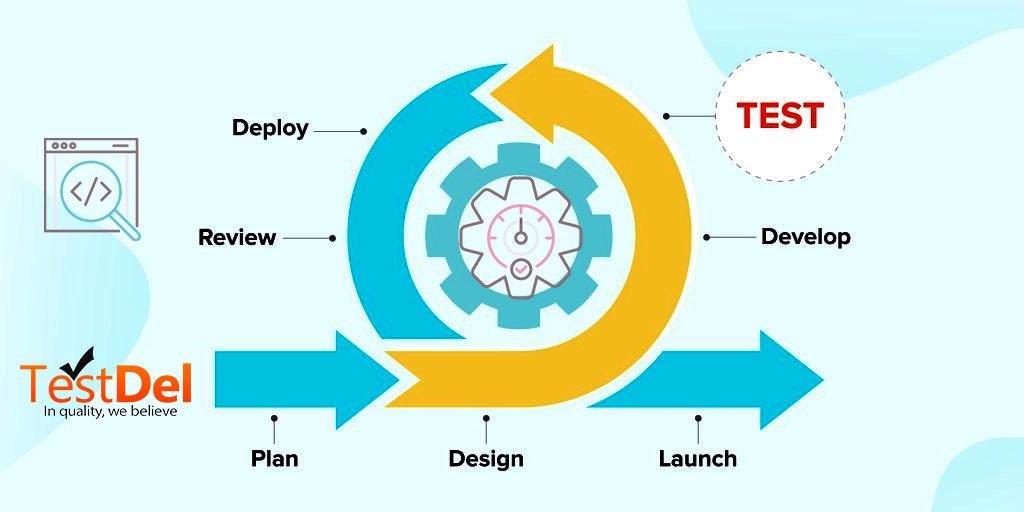
Agile software development emerged as a method for establishing a system that encourages versatility, efficiency, and collaboration. Agile solutions are developed through a collaborative framework and cross-functional team efforts. Its advantages for faster application development cycles and quicker turnaround during challenging situations are being realized by new-age organizations with a growing world. Shorter and faster development cycles, on the other hand, are often challenged as to their accuracy, which is where Quality Assurance (QA) comes in. Although quality provides validation, it cannot restrict the process of software development or slow it down. Quality assurance on the other hand, becomes an important part of the equation, particularly when it comes to providing validation and ensuring the application’s consistency.
Agile is all about working together to accomplish a shared goal for people who have different abilities and mindsets. A conventional scrum team consists of developers (both front-end and back-end), quality assurance specialists, and a scrum master. When we refer to QA as a team, it automatically establishes a barrier between developers and testers, and it deprives developers of the obligation to test their own work and deliver high-quality code because there is a “QA Team” that will work diligently to discover all of the system’s flaws. This operating theory is closely related to waterfall and V-model ventures, “putting the code over the wall” mindset that results in poor quality applications, which is exactly what agile methodologies are trying to address
The QA function is a necessity in any project methodology, including Agile. The work requested in a project must be verified before it can be considered complete, especially before it reaches an end-user. The function of QA is to test what has been developed, comparing the actual result to the expected result.
QA Role in Agile
- Agile development necessitates the collaboration of both testers and developers, and the roles may be exchangeable. As a result, it is critical that the requirements are set and that the team is well aware. Testing will be involved from the moment the user stories are written. The intended scope of work must be clearly understood by both the production and testing teams.
- Agile development is much more experimental and creative. The functions can shift, and the scope of the project can change with time. To produce the application with validated codes, the testing team must work together successfully across the development cycle. In agile, the role of QA may include both testing and production. The concept is that developers and testers must work together to produce code and execute the task according to the client’s specifications.
- The QA function is not specifically associated with any of the agile teams, but it serves as a resource for SMEs around the organization, promoting best practices in the development of high-quality applications. The QAs in agile teams are motivated to be the QA character for their respective teams, making sure that their groups utilize the best practices established by the QA function and seeks for Continuous Testing.
- QA aids in the early detection of problems and possible defects in an application during development cycles. It can also assist with issues such as accessibility, efficiency, and protection. This will not only maintain device reliability, but it will also reduce testing efforts until the software is in the hands of consumers. This allows developers to step forward without having to constantly deal with unresolved problems or redesign.
- The QA team provide fast input when coping with unresolved problems and work together with the development team to resolve the issues.This allows developers to adapt quickly to changes and switch back and forth as the application is being developed. It also results in the reduction of efforts, as well as time and costs. Finally, it promotes quicker turnover and cost-effectiveness, all of which are critical in the digitalization age.
- Agile methods provide teams and individuals with the requisite ownership when working on projects. QA, on the other hand, allows teams to maintain relevance and consistency when churning out code and deciphering client briefs. Teams can produce creative applications in this way, thanks to continuous teamwork and versatility.
What does it take to create an effective QA schedule for your Agile Development?
A QA must be an integral part of the agile team right from the beginning, and not just included during later stages. While the role of QA is many times overlooked in an agile project, it is crucial to understand that the job of a QA cannot be underestimated. To make the process efficient and verify each phase, QA must be integrated into every development approach. At the same time, it cannot interrupt the development process’s rate. So, an important and well suited QA strategy entails:
- Maintain a result-oriented approach to QA
Agile development focuses on achieving shorter goals and accomplishing fewer objectives. This means that QA must work inside the Agile equation, which is much faster and more complex. A team’s ability to produce outcomes that move them closer to their end goal can be greatly aided by a results-oriented approach.
- Maintain objectives’ clarity
When clarity is retained, Agile or some other modern software development method works well. It is important to keep things in the open when operating in an Agile environment, whether it is with clarification of priorities or transparency in the process. This will help teams in collaborating effectively and meeting deadlines.
- Consider testing a continuous process
Testing can’t wait for the end of the period to be finished. It is important to incorporate it into the production process. It must occur during the cycle, with the QA workload being spread throughout the cycle, allowing teams to find problems earlier rather than later. When testing and production are combined, both teams are able to address problems more quickly and with higher quality.
- Organize developer demonstrations
The importance of in-person demonstrations and meetings cannot be overstated. As a result, whenever possible, organize face-to-face demonstrations of various application characteristics from the development team. This will lead to more involvement from the QA team and will aid in the clarification of issues in person.
Conclusion
Agile teams need QA as much as any other traditional team. However, the roles and responsibilities of the QA may vary and include more technicalities, and encourage deeper involvement, depending upon the scope of the project.
Many companies in different stages of Agile adoption have turned to TestDel as a reliable testing partner. We’ve assisted companies new to Agile in incorporating quality assurance preparation, estimation, and measurements into their sprints.
Contact our Agile experts and get started on your Agile plans with trust.