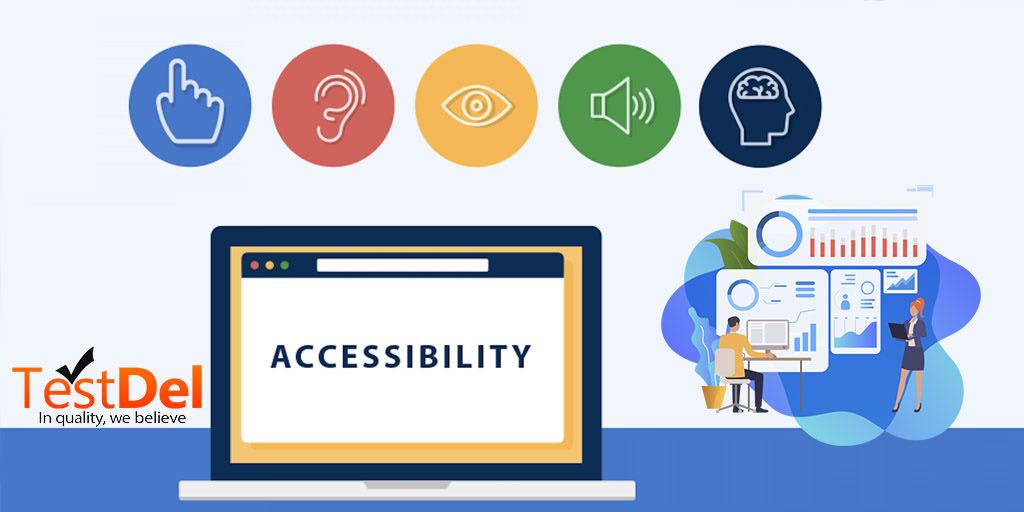
The modern world has resulted in a boom in digital technology adoption, whether it’s for digital payments or business cloud adoption. The Covid-19 pandemic not only sparked the digital revolution, but it also highlighted the importance of online accessibility so that tech-enabled goods would reach a wider audience. According to the accessibility foundation’s report, the online accessibility market is worth $250 billion. Web accessibility is now more important than ever. As a result, technology enablers must place a greater emphasis on accessibility testing than ever before.
Acknowledging this underserved market can be extremely beneficial for businesses that have online products with a razor-sharp emphasis on open web experiences. Partnering with an accessibility testing company will help you speed up the web accessibility testing process and gain an advantage over its rivals. W3C’s Web Content Accessibility Guidelines (WCAG) are organised around four key principles known as POUR – Perceivable, Operable, Understandable, and Robust. So now you understand the importance of accessibility testing, it’s time to explore the various aspects of accessibility testing.
What is Web Accessibility Testing?
The web is open to all and it is our duty as testers (who are also humans) to ensure that it is available to all users. This, in turn, will contribute significantly to a company’s success as we work to make the application available to all users. This will improve user retention as well as our bottom line.
Accessibility testing is the process of evaluating a web application to ensure that it is accessible to all users. Online accessibility testing is a specific and dedicated branch of testing that helps ensure that websites are successful in this field. Most significantly, there are certain laws and standards that must be followed when conducting usability research.
Web usability testing is a form of testing technique that ensures that a web app (or website) follows the W3C’s POUR guidelines. People with disabilities such as hearing loss, blindness and visual impairment should be able to use the app. Web accessibility testing isn’t just for web (or mobile) apps. “It’s for any product that comes under the category of “internet accessibility.”
The four main concepts outlined by the W3C in its Web Content Accessibility Guidelines are as follows:
Perceivable
The information given to the end-user must be generated in such a way that they can understand it.
Operable
The user interface should be operable and open. Keyboard strokes should be used to make web page navigation easier.
Understandable
The information must be written in a way that is simple to comprehend. Color-coded instructions should be used so that any errors can be quickly identified on the website. For example, highlights can be used when the user enters an incorrect password or when a mandatory field is not filled by the user.
Robust
When developing a product for improved accessibility, the robustness and reliability of the content is critical. Different user agents must be able to access the content.
Why is Accessibility Testing important?
It’s vital for companies to allow and make their critical software and mobile apps available to all including people with disabilities. Several governments around the world have passed legislation to make IT goods more available to people with disabilities. Furthermore, WCAG 2.0 is a definitive guideline that should be followed by companies during the production of their websites. These guidance can be accomplished by using usability tests that can assist in a variety of ways, including:
- Users with impairment or difficulties have easy and effective access.
- Enhances reliability and productivity while increasing market share and audience reach.
- Present and potential legal standards were met, and principles were adhered to.
- Globalization should be encouraged.
- Helps low-bandwidth users with connectivity.
The Need for Accessibility Testing
According to the World Health Organization (WHO), 15% of the population has an impairment, emphasising the importance of accessibility testing. It is important that product innovations are delivered to people with special needs as well. They necessitate the incorporation of advanced technology into goods. Screen magnification software, screen readers, speech recognition software, special keyboards for work and communication and other technology are among them.
However, there are a number of creative products, software, and websites that are not user-friendly or universally available. The Accessibility Test is designed for both average users and people with various disabilities. The aim of an accessibility test is to ensure that an application can be used by people with a variety of disabilities, such as visual, auditory, physical, voice, cognitive, language, learning and neurological disabilities.
Types of Web Accessibility Testing
Accessibility testing, like other types of testing, is divided into two categories:
Manual Web Accessibility Testing
This is the simplest way to check the keyboard’s functionality. The TAB key on the keyboard is used to perform manual web accessibility testing. This will emphasize every hyperlink on the web. The user will be able to easily navigate to the suitable link as a result of this. In web accessibility testing, popular screen-readers such as TalkBack, VoiceOver, JAWS, and others are commonly used. These tools read out what’s in the application, making it easier for people with visual impairments to navigate the platform (or web app).
Automated Web Accessibility Testing
A range of plugins (or add-ons) for Chrome and Firefox cater to web usability checking. Some of the common accessibility testing tools include Web Accessibility Toolbar, Axe for Chrome (and Firefox), JAWS Inspect, and Accessibility Inspector. Choosing the best tool for the job is critical for speeding up the accessibility testing process. TestDel has assisted a number of businesses in scaling up by making their websites and apps more accessible.
How to Perform Accessibility Testing?
A website, product, or application’s accessibility test typically entails a thorough manual review of individual pages, as well as checking individual functions such as product searches and online form submissions. Manual and automated testing of basic elements of emerging technology may be used to achieve accessibility.
Benefits of Accessibility Testing
-
Increases website traffic and economy share
It would be easier for people with disabilities to navigate websites effectively if web accessibility strategies are used and this will result in a significant increase in traffic.
-
Enhances the identity of the company
The approach of web accessibility not only makes it easier to understand the website, but it also helps to improve the user’s approach and ensures a positive impact on their website or application as well as help to create brand awareness.
-
Allows the website available to the general public
The accessibility test ensures that the application is equally open to people with disabilities and that they have an equal number of opportunities. This method of accessing the internet regardless of disability would result in a more productive community.
Let’s make websites more user-friendly and accessible
At least some level of accessibility is available to a large percentage of the world’s population. To increase the usability quotient of websites, businesses must take advantage of the benefits provided by web accessibility testing. It is critical to meet the needs of the community as smartphone and internet penetration rises . This is where web usability testing will help them meet their technical requirements. With the fierce competition in the tech industry, partnering with companies like TestDel who have experience and expertise in delivering a variety of usability testing services is essential.
Conclusion
Making accessibility testing a routine part of the software testing process and performing the required tests early and often can help to enhance the overall experience of using an app or website. If the world moves toward bettering the user experience, it’s critical that an application’s usability be checked.
Strong user experience is directly proportional to good accessibility. Despite the fact that accessibility methodologies differ, the trend toward user-centric IT consumption habits will continue to drive customer and enterprise IT requirements in the foreseeable future. Human-centric design and overall usability testing will become more relevant as the trend toward greater accessibility continues.